Search This Blog

Get ready for it - the Gospel of Judas!

With superbly timed marketing, slap in the middle of the run up to Easter, in the wake of the Da Vinci Code book, and in anticipation of the film, the Gospel of Judas hits the streets in book, film and magazine formats!

Sadly, in the journalistic hype the overlooked details of this case are plentiful and significant. Hardly 'unknown' the text has been known about for decades (although not translated). It isn't a complete text. The manuscript itself dates to around 300. The text it contains was possibly written up to a century after the New Testament Gospels - and not by Judas. And it fits perfectly with other Gnostic texts in its complete lack of interest in the real physicality and historicity of Jesus.

I can already hear the sound of money pouring into publishing bank accounts... and the equally load groans of boredom from the poor sods who buy the thing expecting a STUNNING NEW REVELATION about the REAL JESUS who MARRIED MARY MAGDALENE!

Well sorry, no such luck.

Turns out the early church was pretty discerning in what it decided constituted a good account of the life and significance of Jesus, and what was just away with the faeries... (ok, not fair on gnostics - the text is another useful insight into second century gnostic belief, I should aim my frustrations as the publishers)

The more interesting story is the manuscript's journey through the black market and the attempt to flog it for $10 million. Thankfully the views of genuine scholars are slowly reaching the press (although always just too late...).

Speaking personally I've always been extremely moved by Judas' tragic story and his repentance by suicide. Judas is scarcely more hostile to Jesus than Peter denying his friend outside the High Priest's house. I blame Dante for popularizing the image of Judas frozen in the devil's mouth in the depths of hell.

For the interested a quick sample:
Judas said, “Master, as you have listened to all of them, now also listen to me. For I have seen a great vision.”

When Jesus heard this, he laughed and said to him, “You thirteenth spirit, why do you try so hard? But speak up, and I shall bear with you.”

Judas said to him, “In the vision I saw myself as the twelve disciples were stoning me and [45] persecuting [me severely]. And I also came to the place where […] after you. I saw [a house …], and my eyes could not [comprehend] its size. Great people were surrounding it, and that house a roof of greenery, and in the middle of the house was [a crowd—two lines missing—], saying, ‘Master, take me in along with these people.’”

[Jesus] answered and said, “Judas, your star has led you astray.” He continued, “No person of mortal birth is worthy to enter the house you have seen, for that place is reserved for the holy. Neither the sun nor the moon will rule there, nor the day, but the holy will abide there always, in the eternal realm with the holy angels. Look, I have explained to you the mysteries of the kingdom [46] and I have taught you about the error of the stars; and […] send it […] on the twelve aeons.”

Nice change to find a laughing Jesus, though.

For those who want a more extensive free peek, or a look at some of the surrounding press comments.

Reading is Believing

David Cunningham has been a recent discovery over the past few years for me, beginning with his These Three Are One, one of the most accessible and relevant books on Trinitarian theology I've ever come across. (How often do you find a theology tome that includes words for a new hymn?).

Cunningham has a profound interest in the reception of theological doctrine, not just its formation (see his Faithful Persuasion).

This work, Reading is Believing, sees him trying to explore the Apostles' Creed for the general laity in the form of a book/film-club.

Interesting idea; I've just finished his section on the incarnation which (rightly) cooks a snoop at unwitting modern Christian docetism by holding up The Last Temptation of Christ as a profound meditation on Jesus' full humanity.

I'll post the best bits (as I see them). But to start with I loved his charming advert to the legendary origins of the Apostles' Creed:

Apparently, so the story goes, it began with the 12 disciples (Matthias replacing Judas) sitting together when Peter pipes up, 'I believe in God the Father almighty, creator of heaven and earth...', to which Andrew adds, 'And in Jesus Christ, God's only son, our Lord'.

I fondly imagine each apostle pitching in one at a time with their reflections. Most poignant of all, to whom is the fifth article of the creed ('Descended into hell, on the third day rose again from the dead') ascribed in the legend? Why, who else but that great doubter: Thomas.

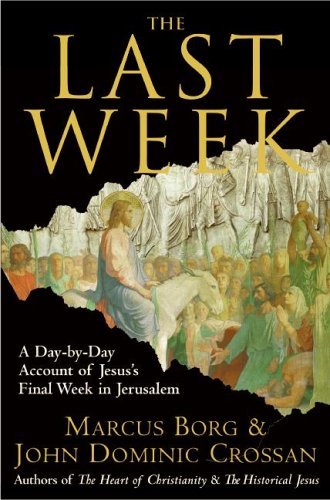
The Last Week

This looks fascinating - but can it be any more gripping than the original?

The publisher's blurb reads:

"Using the gospel of Mark as their guide, Borg and Crossan present a day-by-day account of Jesus's final week of life. They begin their story on Palm Sunday with two triumphal entries into Jerusalem. The first entry, that of Roman governor Pontius Pilate leading Roman soldiers into the city, symbolized military strength. The second heralded a new kind of moral hero who was praised by the people as he rode in on a humble donkey. The Jesus introduced by Borg and Crossan is this new moral hero, a more dangerous Jesus than the one enshrined in the church's traditional teachings."

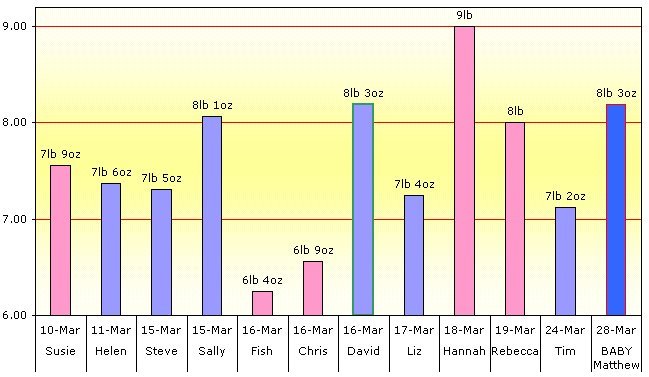
And the Winner is...


Sally has announced the winner of the Chaplaincy sweepstakes on the stats for our new baby! Thanks Sally. The winners get to change a nappy each.

April Fools


I'm always falling for these. Perhaps I just take life too seriously.

My two favourites were the news about the
first woman archbishop

and this hilarious one about an really creative
alternative worship event.

Lost in Wonder for Steam


My toddler and I went to see a model steam railway this afternoon. What things of glory these hand-built engines are - beautiful craftsmanship. Each costs several tens of thousands of pounds.

Fascinating, too, that most of the people young and old were boys/men (the only women I really noticed were talking about how to keep the club house well maintained - obviously the ones with real responsibility!).

Meanwhile James - and I - were mesmerised and lost in wonder. How did a fondness for little steam engines get in our genes? It certainly goes deep...

Submissive wives no more!

Paternity leave has left me with (a little) time on my hands, and has given me the chance to read a few other blogs.

Dave (a UCCF worker with the Christian Union in Reading University) keeps a blog. His recent thoughts on 'wives submitting to husbands' (according to some readers of the Letter to the Ephesians) provoked me to reach for the Greek New Testament and a few commentaries.

Having often heard Conservative Evangelicals trot out the 'wives should submit to their husbands' line, I was pleasantly surprised to learn what the Bible really says.

The (mis)quote comes from Ephesians ch.5.

Several observations can be made:

1) The author begins by stating that every Christian should 'submit' to every other Christian. This envisages the creation of a sort of love communitarianism with the intention of countering any one individual's pride. 'Submission' is thus a general ethic (according to the writer) and not a vocation merely for Christian wives.

2) Most surprising of all is that the earliest Biblical manuscripts (dating to around 200 AD) don't have the phrase 'wives submit to your husbands' at all. The verb is missing (only added by latter copyists). Whenever the phrase is used by modern preachers it is - at best - misleading as it is hopelessly out of context, or - at worst - simply 'unbiblical' (to use an evangelical phrase).

3) An ethic of 'submission' is, however, still present in the passage. What the writer seems though to be getting at when it comes to how husbands and wives should treat each other is a matter of mutual deference. Submission by one partner to the other is to be perfectly balanced by the surrender of the other to the wishes of the first...

All very abstruse. But a relief to be able to rehabilitate that part of the Bible.

'Pass the chocolate, dear, and make me a cup of coffee will you... ouch! ... Ok, I'll do it myself - want one, too?'

With thanks to Dave for prompting these reflections and to John Muddiman's commentary on Ephesians. The full exchange of views can be seen here.