Master and Commander meets
Origin of Species in this superbly exciting novel. In
This Thing of Darkness we follow the intellectual and nautical journeys of HMS Beagle, her Captain Robert FitzRoy, and most famous passenger, Charles Darwin.
As is well known, Darwin's time on board the Beagle furnished him with the material to compose his theory of evolution by natural selection. What Harry Thompson's impressively researched, lightly-told and frequently humorous book does, too, is to reveal the many other stunningly impressive scientific advances her crew made and the acts of heroism these involved.
Against the background of powerful natural and human adversity, under its inspirational and at times mercurial Captain, this tiny vessel's crew made incredible discoveries in disciplines as diverse as navigation, geology, anthropology, botany and meteorology.
But this thrilling novel is not just about external journeying. The 'thing of darkness' to which the title alludes refers not just to the illumination of previously unknown geographical, or even intellectual, information. We are party, also, to the exploration of the darker recesses of the human person.
Thompson makes us witnesses to the ill effects of human greed, ignorance and (with great pathos) naive idealism. And he does this with nods to the present which are, by turn, wry, poignant and savagely critical. It is these recurring allusions to the present that make this novel transcend the genre of nautical yarn and lift it to the status of modern-day parable.
Colonizing settlers are thus shown exterminating native 'terrorists' and justifying their deeds with words and sentiments cleverly borrowed by the author from George Bush and Tony Blair's 'War on Terror'. The aftermath of a tsunami is vividly rendered with descriptions reminiscent of recent news footage. The tale of an experiment to civilize Patagonian natives ultimately risks personal and tribal disaster, and a comment about modern globalization and its effects on ecologies and cultures can clearly be heard as an echo.
Throughout this, though, there is also an on-going exploration into the way scientific and religious arguments interact. Here the writer does not simply re-enact before us the clash and sparks of abstract thought, but more movingly lays bare their effect upon the darker places of the human personalities who think them. This is a tale at whose heart are two very unique individuals, whose personalities and beliefs are initially complementary, but finally irreconcilable.
In the context of the present debate about Creationism, Intelligent Design and Neo-Darwinianism which has in recent months touched schools, courtrooms, archiepiscopal pronouncements and even recent episodes of
West Wing, this novel is not only viscerally gripping, but also intellectually and emotionally engrossing.
There is an ironic and final pathos about
This Thing of Darkness. It was both its young author's first and last novel. Harry Thompson succumbed to his own encounter with natural selection in the form of lung cancer. It was not before he was aware though that his brilliant novel had been long-listed for the Booker Prize. A superb beach novel, particularly if that beach is a raised one, five thousand feet up in the Andes, and littered with fossils.
(c) M.Laynesmith, 2006.




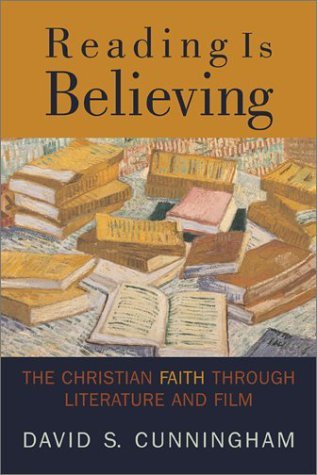 Excerpt from David Cunningham's Reading is Believing on the fourth article of the Apostles' Creed (p. 83).
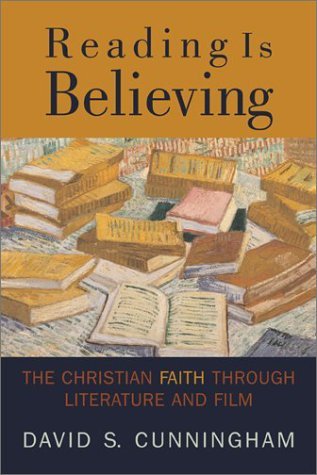 Cunningham ends his series of literary reflections on the Apostles' Creed by noting the presence of the final word: 'Amen':