Problems with photos
For all those having problems with uploading photos (as I have had) here's a lovely trick - delete all cookies before each and every photo upload. Seems to work fine.


If God were a biscuit...
 I was a guest at a 'grill a Christian leader' event a few nights ago at my church's youth group, Elements. Lots of very profound theological and philosophical questions: did God create us because he needed us - was God lonely? Does God love angels more than humans? Is God like me [the questioner]? Does God watch us like Big Brother? (And to kick it off: if God were a biscuit, what kind of biscuit would God be like?).
One of the questions that we thought longest about was on the subject of intercessory prayer (doesn't God know already? why does God seem to intervene only intermittently?)
One insight we ran with for quite a while was the realization that in Hebrew the word for 'prayer' (tephillah) is reflexive. It technically means 'to pray to oneself'.
 In this sense one might argue that part of the power of prayer is that it changes the person who prays.
There's an example of this when Christ prays at his most extreme moment of mental agony, in Gethsemane. There he seems (as the Gospel writers tell it at least) to reuse parts of the prayer he earlier taught his disciples. "Let this cup pass from me, but not my will but your will be done" (cf. "may your will be done on Earth as it is in heaven...").
In other words, Jesus does ask God to bring about a change in the world, ("take away this cup...") but at the same time he offers up a change within himself to God ("but not my will..."). He is both attempting to 'change' God, but in the process he brings about a change in himself.
To those who ask, are Christians being optimists when they pray? The answer should be no: an optimist would only pray the first part of Jesus' prayer and assume that it will be accomplished ("I expect God to change the world, if I but ask!"). But neither are Christians pessimists: that would be to pray only the second part of Jesus' prayer ("I expect God to change nothing except me!").
Rather, Christians are people of hope. They are people who both dream of, and cry out for, a changed world. But they also accept that if that change is not presently able to occur, all is in God's hands anyway and our loving trust is to be offered regardless of the wider outcome. The answer to our prayer may - at least in the short term - be about us changing, not the situation we directly prayed for.
It was not just Gethsemane where this insight is realized. It is also witnessed to in the old story of Shadrach, Meshach and Abed-nego in the book of Daniel. As they are cast into the fiery furnace for not worshipping Nebuchadnezzar, they reply to the king's threat with words of hope (not optimism):
'If we are thrown into the blazing furnace, the God we serve is able to save us from it, and he will rescue us from your hand, O king. But even if he does not, we want you to know, O king, that we will not serve your gods...' (Daniel 3:17-18).
That kind of prayer (and that kind of faith) seems to me to be a long way from the triumphalism that often accompanies Christianity - and leads to disillusion.
X-Men 3: The Last Stand
 Aside from an excuse to escape for two hours into fantasy violence, my interest in a possibly deeper value in X-Men 3 was piqued by an interview I saw of Ian McKellen by Jonathan Ross. "It's all about how society deals with people it thinks are different," McKellen said. And then with a slight raise of the eyebrow and a look into the camera reinforced his comment with an ironic self-reference. Most people in the audience clearly knew of his homosexuality and showed they had got the message by laughing knowingly.
As I saw the film McKellen's interpretative key was in my mind. He was right, X-Men 3 really is about diversity and conformity. For those who don't know the basic series plotline it's this: some people are born with so-called 'mutant' genes which give them superhuman powers; society distrusts this hidden social element and wishes to control it; the 'mutant community' splits between moderates who aim for social inclusion and a violent fringe who want to dominate the non-mutant human population.
With the swiftest of glances one can see resonances between the fictional 'mutants' and various real-life 'outsiders' in the history of the West: Jews, women, Catholics/Protestants, blacks, Asians, gays, immigrants - most recently Muslims - and in every age the mentally ill. Moreover, one can trace this particular film's plot-line, the discovery of a 'cure' for the mutant 'X' gene, in various attempts to 'cure' both homosexuality and mental illness by psychotherapy or genetic manipulation; to 'treat' the 'problem' of the Jews through ghettoisation, sterilization or murder; or at the 'softer' end of the argument to tag, impound or deport illegal immigrants. There are plenty of possible allusions one could chase down.
Perhaps one shouldn't expect much more from a comic-based Hollywood fantasy than easy allusion, but the film does also surprisingly hint at part of a Christian response. Admittedly this is heavily overlaid with the usual myth of redemptive violence (in this case the apparent self-sacrifices and resurrections of Wolverine and Xavier which have nothing to do with the stories of Christ and the martyrs and their self-offerings [tip: watch right to the end of the credits for an extra scene]).
Halfway through the film though, at a key juncture, when the 'mutant community' has to decide how to respond to the invention of a 'cure', a meeting takes place in an abandoned church building. It's curious as to why this set is chosen, and why the building is shown in ruins. What's even more fascinating is the name of the church. A shot of a poster advertising the meeting reveals it is 'Holy Trinity'.
For much of Christian history, Christians have lost sight of the Trinity, assuming that Christianity was simply another (better) form of monotheism. Though heresies like Arianism were rejected (one virtue of the dreaded Da Vinci Code is that people have now at least heard of Nicea!), Christianity has long tended towards a monarchical view of God. The 'Father' is at the top and is pure God, 'Jesus' is a bit lower down the scale obedient to his Father but confusing everyone by being half-man/half God, and the Spirit sort of floats around and is just everywhere in some vague inoffensive way. With such a view of God, a version of society based on hierarchy, order, obedience and conformity is easy to legitimise.
Naturally I overdraw the matter, but any real sense of the Trinity as an inter-penetrative dance of equals has until recently been lost. (It was the Greek Fathers in the fifth century who first used the image of dancing to draw out the fragmentary treatment of the Trinity offered in the New Testament). Consequently any alternative model for a society incorporating diversity has had no real theological justification.
In the past century Christianity's ideology of a monarchical single authority which must be obeyed was taken over into the philosophy of Modernism. With the rise of Modernism's fascist, communist and capitalist children an all-powerful Father figure was supplanted by their own all-powerful father figures: Hitler, Stalin, Mussolini, Pol Pot, Mao, or more nebulously by capital itself.
Ironically then, though some Christians habitually criticize the advent of Post-Modernism, it has precisely been the rise of skepticism toward unique authority figures that has allowed a rediscovery of the Trinity.
God, we are slowly beginning to discover again, is not perhaps a divine dictator who requires our obedience. God is more like a community of difference and equality into which we are invited. Indeed with the Incarnation of the Word as flesh and then the later bodily Ascension of Jesus, God succeeds in incorporating the Creation into the divine dance: humans are 'slaves' to God no longer, we are siblings, children or friends (indeed could we say we are one flesh with God?).
It its own tiny way, X-Men 3 nods towards the Trinity as one possible answer as to how people of difference can coexist. Obviously that needs some serious teasing out in its social practicalities, but it does at least begin to admit the acceptability of a model of diversity-in-unity.
Christians will want to unpack the ramifications of the Trinity through careful study of the way the Persons of the Trinity interrelate and how God's own mutual self-giving might be reflected in our own lives. And though we might feel we are stepping out into new places, St Paul's own treatment of racial, gender and social differences (Galatians 3:28) ought to remind us that we are really only continuing an earlier project: the attempt to realize Jesus' final prayer (John 17:22) that we 'might be One' as God the Trinity is, paradoxically, 'One'.
The Gospel According to Myers-Briggs
The insights of Myers-Briggs into how human personalities fundamentally differ in quite interesting ways, has radical implications for preaching.
Below is a scanned-in section of a Myers-Briggs inspired commentary on the Gospel reading for Pentecost (John 15:26-7 & 16:4b-15). As someone who has been preaching for a fair few years it is humbling to think how what I consider to be a good sermon may mean nothing at all to someone else...!
What follows is taken from Exploring Mark's Gospel, An Aid for Readers and Preachers Using Year B of the Revised Common Lectionary, by L. J. Francis & P. Atkins (pp. 224-7).
Context
At the supper table immediately prior to his betrayal, Jesus promised his disciples that, after he is taken away from them he will send to them the Spirit of truth, the Advocate, the Holy Spirit. The promise was fulfilled on Pentecost Sunday.
Sensing
Sometimes a good picture can say so much more than a whole book full of words. On that first Pentecost Sunday, the church was given a profound picture concerning the nature of God the Holy Spirit The Holy Spirit came to those eleven disciples like a mighty rushing wind. Forget the words, and for now just live for the picture.
The Spirit came like a mighty rushing wind, and the wind is right here. Open your eyes and look for the wind. At first you see nothing. Then you remember how you see the wind blow the washing on the line, how the clothes hanging there are brought to life. You remember how you see the wind pick up sheets of paper and blow them along the street. In the same way, you can see the effects of the Holy Spirit on the lives of people.
The Spirit came like a mighty rushing wind, and the wind is right here. Stretch out your hands and touch the wind. At first you feel nothing. Then you remember how you feel the wind blow you along the promenade on a blustery day, transforming your whole experience. You remember how the wind blows sailing boats through the sea and tugs the child's kite into the sky. In the same way, you can feel the effects of the Holy Spirit on the lives of people.
The Spirit came like a mighty rushing wind, and the wind is right here. Prick up your ears and listen to the wind. At first you hear nothing. Then you remember how you hear the wind rustle through the trees and give voice to the voiceless branches. You remember how you hear the wind slams doors shut and rattles the dustbin lids. In the same way, you can hear the effects of the Holy Spirit on the lives of people.
Sometimes a good picture can say so much more than a whole book full of words. Forget the words, and for now just live the picture.
Intuition
Sometimes a good image can stimulate the imagination and spark ideas so much better than a whole book full of words. On that first Pentecost Sunday the church was given a profound image concerning the nature of God the Holy Spirit. The Holy Spirit came to those chosen disciples like tongues of fire. Now what ideas does that image start running in your mind?
Imagine the ancient world without the discovery of fire, for fire gives light in the darkness. Without fire, when the sun goes down, the world is left in darkness. Does not the Holy Spirit bring light into our lives? Then pray that this fire may illuminate the whole world!
Imagine the ancient world without the discovery of fire, for fire brings warmth in the coldness. Without fire, when the snow falls and the ice sits thick on the lake, the world is left shivering in the cold. Does not the Holy Spirit bring warmth into our hearts? Then pray that this fire may warm the hearts of all people!
Imagine the ancient world without the discovery of fire, for fire cooks our food and kills unwelcome bacteria. Without fire, bread cannot be baked, fish cannot be grilled, vegetables cannot be transformed. Does not the Holy Spirit feed our souls with the food of immortality? Then pray that this fire may feed the spiritual quest of all nations!
Imagine the ancient world without the discovery of fire, for fire refines the metals from the rich deposits in the earth. Without fire gold and silver cannot be fashioned into artefacts of beauty; iron and bronze cannot be forged into objects of utility. Does not the Holy Spirit refine the base metal of our lives for the greater glory of God Then pray that this refiners' fire may transform the human race!
The Holy Spirit came to those chosen disciples like tongues of fire. Now what ideas does that image start running in your mind?
Feeling
Jesus offered his disciples many different images through which they could explore their experience of God the Holy Spirit. The image of the Paraclete is one of the most encouraging and enheartening. Sometimes translated as 'Advocate', the word Paraclete means literally 'the one who is called to stand alongside'.
Ever since that first Pentecost Sunday, Christian men and women have been very conscious of God the Holy Spirit being called alongside them as Paraclete in their time of need. Listen to the accounts of the early disciples in the Acts of the Apostles. Remember how, when they were in prison, the Paraclete came to stand alongside them. Remember how, when they were on trial for their faith, the Paraclete came to put words into their mouths. Remember how, when they were martyred, the Paraclete brought them comfort.
Ever since that first Pentecost Sunday, Christian men and women have been very conscious of God the Holy Spirit being called alongside them as Paraclete in their time of need. Listen to the accounts of Christian disciples across the world today. Hear how, when followers of Jesus are imprisoned for their faith, the Paraclete still comes to stand alongside them. Hear how, when they are on trial for their faith, the Paraclete still puts words into their mouths. Hear how, when they face death for the sake of their faith, the Paraclete still brings them comfort.
Ever since that first Pentecost Sunday, Christian men and women have been very conscious of God the Holy Spirit being called alongside them as Paraclete in their time of need. Listen to the accounts of Christian disciples in your own congregation. Hear how, when followers of Jesus are under stress and fatigue, they become aware of the Paraclete called to stand alongside them. Hear how, when they are sick and in great pain, they become aware of the Paraclete called to stand alongside them. Hear how, when they face the hour of death, they become aware of the Paraclete called to stand alongside them.
The image of the Holy Spirit as Paraclete is both encouraging and enheartening.
Thinking
Jesus offered his disciples many different images through which they could express their understanding of God the Holy Spirit. The image of the Spirit of truth is one of the most challenging and controversial.
Throughout the ages, from that very first Pentecost Sunday, the church of Christ has been committed to truth. The danger is that we sometimes imagine that we have got it right from the very beginning, that all truth has been established and communicated in the past. But listen carefully to the words of scripture.
Listen carefully to Jesus' promise to his disciples. Jesus said, 'When the Spirit of truth comes, he will guide you into all the truth.' The verb 'guide' is of extreme interest and great significance. It seems unlikely, therefore, that the Spirit of truth plans to reveal or to present all the answers complete and final for human acceptance. A guide may show the way, but nonetheless still expects us to make the journey of discovery for ourselves. It is worth taking the verb very seriously.
Listen carefully to Jesus' promise to the disciples. Jesus said, 'When the Spirit of truth comes, he will guide you into all the truth.' The future tense 'will' is of extreme interest and great significance. It seems unlikely, therefore, that the Spirit of truth intended to have retired from the appointed task as guide shortly after the first Pentecost Sunday. A guide who remains active in the church is day by day leading the people of God to grasp new insights and new truths of the kingdom. It is worth taking the tense seriously.
Listen carefully to Jesus' promise to his disciples. Jesus said, 'When the Spirit of truth comes 'he will guide you into all the truth.' The qualifier 'all' is of extreme interest and great significance. The church continues to struggle with issues of huge significance, issues of doctrine, issues of practice and issues of morality. On many of these issues, is it not arrogance and foolishness to claim that our view of the truth is complete? Our guide remains with us as the quest for all truth goes on. It is worth taking the qualifier seriously.
The image of the Holy Spirit as the Spirit of truth is one of the most challenging and controversial.
Below is a scanned-in section of a Myers-Briggs inspired commentary on the Gospel reading for Pentecost (John 15:26-7 & 16:4b-15). As someone who has been preaching for a fair few years it is humbling to think how what I consider to be a good sermon may mean nothing at all to someone else...!
What follows is taken from Exploring Mark's Gospel, An Aid for Readers and Preachers Using Year B of the Revised Common Lectionary, by L. J. Francis & P. Atkins (pp. 224-7).
Context
At the supper table immediately prior to his betrayal, Jesus promised his disciples that, after he is taken away from them he will send to them the Spirit of truth, the Advocate, the Holy Spirit. The promise was fulfilled on Pentecost Sunday.
Sensing
Sometimes a good picture can say so much more than a whole book full of words. On that first Pentecost Sunday, the church was given a profound picture concerning the nature of God the Holy Spirit The Holy Spirit came to those eleven disciples like a mighty rushing wind. Forget the words, and for now just live for the picture.
The Spirit came like a mighty rushing wind, and the wind is right here. Open your eyes and look for the wind. At first you see nothing. Then you remember how you see the wind blow the washing on the line, how the clothes hanging there are brought to life. You remember how you see the wind pick up sheets of paper and blow them along the street. In the same way, you can see the effects of the Holy Spirit on the lives of people.
The Spirit came like a mighty rushing wind, and the wind is right here. Stretch out your hands and touch the wind. At first you feel nothing. Then you remember how you feel the wind blow you along the promenade on a blustery day, transforming your whole experience. You remember how the wind blows sailing boats through the sea and tugs the child's kite into the sky. In the same way, you can feel the effects of the Holy Spirit on the lives of people.
The Spirit came like a mighty rushing wind, and the wind is right here. Prick up your ears and listen to the wind. At first you hear nothing. Then you remember how you hear the wind rustle through the trees and give voice to the voiceless branches. You remember how you hear the wind slams doors shut and rattles the dustbin lids. In the same way, you can hear the effects of the Holy Spirit on the lives of people.
Sometimes a good picture can say so much more than a whole book full of words. Forget the words, and for now just live the picture.
Intuition
Sometimes a good image can stimulate the imagination and spark ideas so much better than a whole book full of words. On that first Pentecost Sunday the church was given a profound image concerning the nature of God the Holy Spirit. The Holy Spirit came to those chosen disciples like tongues of fire. Now what ideas does that image start running in your mind?
Imagine the ancient world without the discovery of fire, for fire gives light in the darkness. Without fire, when the sun goes down, the world is left in darkness. Does not the Holy Spirit bring light into our lives? Then pray that this fire may illuminate the whole world!
Imagine the ancient world without the discovery of fire, for fire brings warmth in the coldness. Without fire, when the snow falls and the ice sits thick on the lake, the world is left shivering in the cold. Does not the Holy Spirit bring warmth into our hearts? Then pray that this fire may warm the hearts of all people!
Imagine the ancient world without the discovery of fire, for fire cooks our food and kills unwelcome bacteria. Without fire, bread cannot be baked, fish cannot be grilled, vegetables cannot be transformed. Does not the Holy Spirit feed our souls with the food of immortality? Then pray that this fire may feed the spiritual quest of all nations!
Imagine the ancient world without the discovery of fire, for fire refines the metals from the rich deposits in the earth. Without fire gold and silver cannot be fashioned into artefacts of beauty; iron and bronze cannot be forged into objects of utility. Does not the Holy Spirit refine the base metal of our lives for the greater glory of God Then pray that this refiners' fire may transform the human race!
The Holy Spirit came to those chosen disciples like tongues of fire. Now what ideas does that image start running in your mind?
Feeling
Jesus offered his disciples many different images through which they could explore their experience of God the Holy Spirit. The image of the Paraclete is one of the most encouraging and enheartening. Sometimes translated as 'Advocate', the word Paraclete means literally 'the one who is called to stand alongside'.
Ever since that first Pentecost Sunday, Christian men and women have been very conscious of God the Holy Spirit being called alongside them as Paraclete in their time of need. Listen to the accounts of the early disciples in the Acts of the Apostles. Remember how, when they were in prison, the Paraclete came to stand alongside them. Remember how, when they were on trial for their faith, the Paraclete came to put words into their mouths. Remember how, when they were martyred, the Paraclete brought them comfort.
Ever since that first Pentecost Sunday, Christian men and women have been very conscious of God the Holy Spirit being called alongside them as Paraclete in their time of need. Listen to the accounts of Christian disciples across the world today. Hear how, when followers of Jesus are imprisoned for their faith, the Paraclete still comes to stand alongside them. Hear how, when they are on trial for their faith, the Paraclete still puts words into their mouths. Hear how, when they face death for the sake of their faith, the Paraclete still brings them comfort.
Ever since that first Pentecost Sunday, Christian men and women have been very conscious of God the Holy Spirit being called alongside them as Paraclete in their time of need. Listen to the accounts of Christian disciples in your own congregation. Hear how, when followers of Jesus are under stress and fatigue, they become aware of the Paraclete called to stand alongside them. Hear how, when they are sick and in great pain, they become aware of the Paraclete called to stand alongside them. Hear how, when they face the hour of death, they become aware of the Paraclete called to stand alongside them.
The image of the Holy Spirit as Paraclete is both encouraging and enheartening.
Thinking
Jesus offered his disciples many different images through which they could express their understanding of God the Holy Spirit. The image of the Spirit of truth is one of the most challenging and controversial.
Throughout the ages, from that very first Pentecost Sunday, the church of Christ has been committed to truth. The danger is that we sometimes imagine that we have got it right from the very beginning, that all truth has been established and communicated in the past. But listen carefully to the words of scripture.
Listen carefully to Jesus' promise to his disciples. Jesus said, 'When the Spirit of truth comes, he will guide you into all the truth.' The verb 'guide' is of extreme interest and great significance. It seems unlikely, therefore, that the Spirit of truth plans to reveal or to present all the answers complete and final for human acceptance. A guide may show the way, but nonetheless still expects us to make the journey of discovery for ourselves. It is worth taking the verb very seriously.
Listen carefully to Jesus' promise to the disciples. Jesus said, 'When the Spirit of truth comes, he will guide you into all the truth.' The future tense 'will' is of extreme interest and great significance. It seems unlikely, therefore, that the Spirit of truth intended to have retired from the appointed task as guide shortly after the first Pentecost Sunday. A guide who remains active in the church is day by day leading the people of God to grasp new insights and new truths of the kingdom. It is worth taking the tense seriously.
Listen carefully to Jesus' promise to his disciples. Jesus said, 'When the Spirit of truth comes 'he will guide you into all the truth.' The qualifier 'all' is of extreme interest and great significance. The church continues to struggle with issues of huge significance, issues of doctrine, issues of practice and issues of morality. On many of these issues, is it not arrogance and foolishness to claim that our view of the truth is complete? Our guide remains with us as the quest for all truth goes on. It is worth taking the qualifier seriously.
The image of the Holy Spirit as the Spirit of truth is one of the most challenging and controversial.
Prayer and Personality
ISITEJ | ISIFEJ | INIFEJ | INITEJ |
| Inspector | Protector | Counselor | Mastermind |
ISETIP | ISEFIP | INEFIP | INETIP |
| Crafter | Composer | Healer | Architect |
ESETIP | ESEFIP | ENEFIP | ENETIP |
| Promoter | Performer | Champion | Inventor |
ESITEJ | ESIFEJ | ENIFEJ | ENITEJ |
| Supervisor | Provider | Teacher | Field Marshal |
After chatting with Lou tonight I was inspired to go search for useful stuff on the web which deals with Myers-Briggs typology and prayer preferences.
This is a lovely site with practical examples of how different people do prayer.
Sometimes MBTI can be as refreshing (and unnerving) as looking in a mirror - at other times it can be constricting and unhelpful. Personally I find my INFJ (or possibly P) to fit pretty well and to help me realize why life is so frustrating... (Though there can be a bit of fruit-cakery as here!)
For a while we have been talking in the Chaplaincy about offering a Myers-Briggs and prayer workshop. Maybe there would be enough interest to put one on, or do one in collaboration....?
(Crucifixion) RED
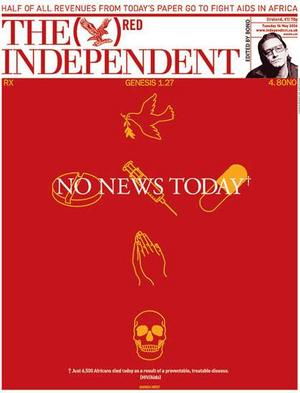
I don't often like Damien Hirst, but his front cover for yesterday's (Independent) RED was very clever and played - as he has done before - with Christian imagery (see his Luke here). (Product) RED is, by the way, a brainwave of Bono to get corporate capitalism involved in the fight against HIV/AIDS in Africa - companies donate some of the profits from their (Product) RED branded products: mobile phones, shoes, clothes etc.
On the front page of the paper, various symbols form a cross-shape: the skull, tablets and needle tell the AIDS story and the fight against it. Combined with them are the clasped hands in prayer and the dove with the leaf in its mouth: a nod both to the Ark story in Genesis 8 (v.11), but also to U2's song Beautiful Day).
There is, then, death and enslavement to tortuous routines of treatment; there is an allusion to the destruction of the world by flood/disease; but there is also prayer and hope...
Putting the skull at the base of the cross is a nice trick - it picks up the placing of Adam's skull at the foot of Christ's cross in Orthodox Icons - a way to make the story of the cross relate to every(wo)man.

Placing the Bible reference at the top is also very perceptive. When Christ was crucified a titulus (a charge-sheet) was placed above his head ("this is the King of the Jews"). The titulus here is from Genesis 1:27: "God created humankind in his own image, in the image of God they were created: male and female God created them".
In other words the image means (to me) that ordinary Africans, God's children and bearing God's image, are being crucified by the AIDS pandemic. We are invited to feel as outraged at this scandal as at the murder of the Innocent One. The death of millions of people with AIDS is a scandal since AIDS is, as the footnote at the bottom of the page puts it, "a preventable, treatable disease".
The bottom line would seem to be: just as Pilate washed his hands of Christ's death - do we wealthy Westeners do the same of Africa's? Indeed we wash our hands daily of it - it is no longer even news to us: "no news today".
This is a fascinating take on how Christ's crucifixion relates to the present day for Hirst. In the corner the figures "4.80N0" appear, i.e. "[This picture is] for Bono". Hirst's choice of religious imagery presumably picks up his understanding of what drives Bono (his faith).
It shows therefore one way of interpreting the Cross, emphasizing the way folk with AIDS suffer as Christ did. In doing this Hirst also implicitly gives Africans's lives the same value as Christ's life - and it points to his yearning for their resurrection, just as Christ has already experienced his.
I tip my hat to Hirst, and salute Bono's brave move out of church halls and student campaigning into the high street...
Subscribe to:
Posts (Atom)