Search This Blog

Desert Wisdom I


We have a weekly email going out over the university holidays based upon the sayings of the desert fathers, a fascinating group of fourth-century Christians who fled the newly Christianised Roman Empire and it's civilized life for the adversities of the desert, here's one of the excerpts...

A certain brother came to Abbot Silvanus at Mount Sinai, and seeing the hermits at work he exclaimed: 'Why do you work for the bread that perishes? Mary has chosen the best part, namely to sit at the feet of the Lord without working'.

Then the Abbot said to his disciple Zachary: 'Give the brother a book and let him read, and put him in an empty cell'.

At the ninth hour the brother who was reading began to look out to see if the Abbot was not going to call him to dinner, and sometime after the ninth hour he went himself to the Abbot and said: 'Did the brothers not eat today, Father?'

'Oh yes, certainly,' said the Abbot, 'they just had dinner'.

'Well,' said the brother, 'why did you not call me?'

'You are a spiritual man,' said the elder, 'you don't need this food that perishes. We have to work, but you have chosen the best part. You read all day, and can get along without food.'

Hearing this the brother said: 'Forgive me, Father'.

And the elder said: 'Martha is necessary to Mary, for it was because Martha worked that Mary was able to be praised'.


Often I find myself giggling when I read the desert fathers. Like many monks I have met, something about living in community brings out and ripens in them a keen sense of humour (Jorge in Umberto Eco's Name of the Rose - currently serialized on Radio 4 - would not have approved!).

Abbot Silvanus gently deflates the young brother's misunderstanding about the 'spiritual life'. The truth is, that none of us can be detached from our bodies and their needs - or our neighbours - and imagine we can enter some form of nirvana privately in our 'souls'.

This is too inhuman - and also too unholy - a path. The message of the Incarnation is basically that 'matter', 'work', 'food' and so on, are good. (Indeed, 'very good', as the Creation story in Genesis puts it - not just necessary).

Though occasionally the hermits did experience strange 'phenomena' (visions of angels etc), the concept of 'spiritual' was really about becoming more fully human. If you like, in this last desert these hermits hoped to return to the first Garden - to an original harmony.

Those who have watched the recent series The Convent, or it's predecessor The Monastery, may have noticed that the vocation the nuns/monks are pursuing is not about achieving some personal 'spiritual' ecstasy. It is much more basic: it is how to live together as God intended, being the person each has been called to be.
I wonder whether the question I ought to ask myself more often is not 'how spiritual am I?', but 'how fully human am I?'.

Who gets the kids?

Thanks to Maggi Dawn for the pointer to Dave Walker's all too true cartoon about the potential break up of the Anglican Church.

More letterbox angels

Yet another odd collection of unbidden donations was posted through our door (this time at 11.30pm) with no indication of the sender. Aside from a well-thumbed copy of Pope's Rape of the Lock and a peculiar local amateur dramatics video, there was also an essay on Jonathan Swift and scatology.

Nosing through the essay, I learnt that mouth-to-mouth resuscitation was only one method of revival favoured in the Eighteenth century. Fumigating the rectum with tobacco smoke was thought of equally highly...

I'm sure Abraham didn't have this trouble with his celestial visitors.

The Convent bites back

Victoria, one of the women in the current series, The Convent, takes me to task for suggesting she was not serious about her time with the Sisters and chosen only for 'entertainment value' (alas my words...).

So public apology time: here is her own site, and also her poetry page on her own Press which adds her side of the story, part of which deals with a past miscarriage. Victoria has published a book of 40 poems based on her time in the convent, Fragments.

She also has links to two other of the women's sites: Debi's and Angela's.

The series continues to be extremely good viewing. In the last episode, the programme focused on Debi hearing God speak to her through the story of Jesus healing a little girl, with the implicit and poignant parallel between the age of the girl in the story and Debi's own age when her mother left her. In both cases, a resurrection is evident...

Art Finalists's exhibition


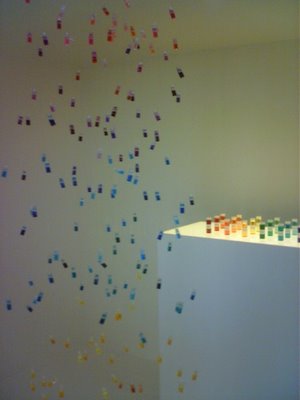
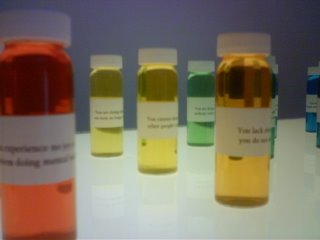
This was one of my favourites - on the theme of colour. Very simple, really: coloured water(?) in little glass vials hung in a rainbow sequence from the ceiling.

Whatever else the artist may have intended (and on the glasses in the background each vial had a curious personally critical, Alice-in-Wonderland, type message attached), I thought her work was just quite beautiful.


This outdoor installation - balloons attached to concrete blocks - also caught my eye. Platonic spirituality - spirit wanting to escape matter? - or dreams tied down by reality?

The Convent


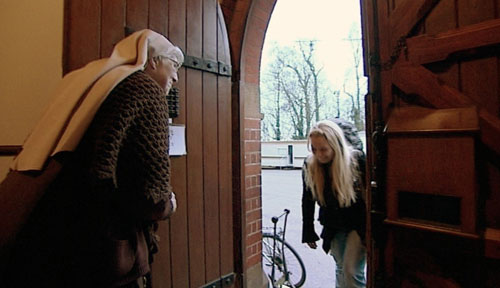
A new series, The Convent, has just begun on BBC2. It runs for the next 3 Wednesdays at 9pm, following the stay of four women at a Roman Catholic convent for 40 days. I find it a fascinating watch - as I did a previous series focusing on five men who similarly stayed in The Monastery. It was filmed at Arundel, and has a great site here which even includes personal pages for each of the sisters.

What has been so brilliant about the two series is the way in which, surrounded by a Christian community, many of the deeper issues of human existence have come to the surface for the particpants. Each have sought to find God at work among the building blocks of self-worth, moral failure, ingrained personality traits, foundational memories and questions of life direction.

In this version one of the women is a recent evangelical convert and ex-alcoholic running on the spiritual equivalent of cocaine. Another is a deeply emotionally-scared woman abandoned as a child who thinks God is punishing her. A third is a successful single, driven business woman who feels her life is shallow and can initially only see time as a utilitarian resource for achieving surther success. And the fourth - obviously chosen for entertainment value by the producers - is an atheist hippy who lives in an open marriage.

It sounds like ecclesiastical big brother, but I think it avoids such crassness.
What I really love about these programmes is that they show that the heart of Christianity is about the remaking of whole people in Christ's image (as opposed to the car-salesman view of Christianity where the aim is simply to succumb to a "do you accept Jesus as your personal Lord and Saviour?" pitch or risk a roasting in hell).

I've not seen the full series yet, but going on the press reviews The Convent seems to be able to weave its healing magic to varying degrees for its inmates, just as The Monastery did for the men.*

It's well worth a sympathetic meditative viewing (in between the football, that is).

[*For those who missed the first series, in the case of The Monastery, filmed at Worth Abbey, one guy said his encounter with God caused him to leave the soft-porn industry; another revisited the idea of a vocation as a priest; an ex-paramilitary gave up his job to work in prisons; and even the toughest of the group decided his high-pressure high-income career was no longer his life's calling. Only an older poet seemed not to be changed much...]

Angels and Nipple Cream

Ever since we became a clergy family people have taken to leaving things on our doorstep. They are usually unlabelled, so we never find out who our angels are. But judging by the items, I'd say they must be pretty weird.

Here's a short list from memory:

black PVC maternity trousers (for a woman of under 5' 6" - my wife is 5' 10")
6 fresh cream chocolate profiteroles
a half-full box of breast pads
half a chocolate Easter egg
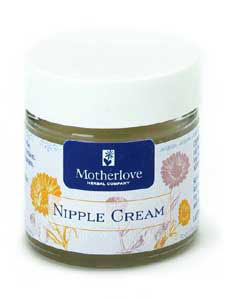
some nipple cream
and, an oversized maternity bra


And just last week, prompting my musings, there appeared on our doormat:
a medium-sized bag of chopped red, yellow and orange peppars and a small pot containing more of the same, labelled 'traffic lights'.

Of course I could mention other bizarre consequences of being public property: the time we came home to find our next door neighbour had mowed our lawns for us, and the other time we found they had run their washing line from the middle of our garden over the fence into their garden...