Search This Blog

Desert Wisdom IV


Abba Anthony also said, 'Just as fish die if they stay too long out of water, so the monks who loiter outside their cells or pass their time with men of the world lose the intensity of inner peace. So like a fish going towards the sea, we must hurry to reach our cell, for fear that if we delay outside we will loose our interior watchfulness'.

Though none of us are solitary hermits (for which some of us may well thank God!), is there still anything we can learn from Anthony's strong warning against monks loitering outside their cells?!

Perhaps.

I recall a time some years back when prayer and worship had become particularly arid. I had lost the 'intensity of inner peace' that Anthony talks about. And that was due, largely, to my rushing around.

I went to a spiritual director and told him about this, and he asked me a surprising question: 'What have you *really* enjoyed doing in the past couple of weeks?'

Rather guiltily, I responded that the most enjoyable thing I could remember doing was going to an Italian restaurant on my own, having a pizza and a large glass of white wine, and slowly eating it, whilst I watched the river pass by and the sun glint off it.

Just in the process of describing it again to my director brought back the intensity of the moment - its rejuvenating calm.

The spiritual director clapped his hands together with the glee of a doctor who has diagnosed his patient. 'Right,' he said. 'That's what you're to do once a week. Find something you really enjoy and treat yourself'.

I doubt any onlooker - or even Abba Anthony! - would consider my solitary lunches to be moments of prayer. But they became key moments when I slowed down, and reentered God's presence.

In a sense, those weekly meals became the 'cell' into which I retreated and where my 'intensity of inner peace' was restored.

It is a salutary lesson: rushing around in the busy world does gradually take its toll. We all need a 'cell' - a safe, quiet place to be with God. For each of us this will be a different place. Without time in God's presence we become like fish out of water.

Madonna's Blasphemy?


Last Sunday I was asked by Radio Berkshire to comment on Madonna's latest antics - appearing on stage hanging on a mirror-ball cross whilst wearing a crown of thorns. Apparently there was 'unanimous condemnation' by Christian, Jewish and Muslim groups.

I replied, much to the interviewer's surprise, that I wasn't particularly offended and that it was probably just another silly publicity stunt (which has succeeded again). But I did say that I would be rather curious to know what song it was that she sang whilst imitating Christ, as I wondered whether it would turn out to be something religious.

I learnt the details this morning that the song was her 80s track Live to Tell (lyrics here).

According to one report: "With silver cuffs holding her arms in place, Madonna sang while images of third-world poverty and numbers representing the 12 million children orphaned by AIDS in Africa ticked by on a screen."

I've always rather liked the track (ok it is a bit sentimental): its mysterious 'secret' which the singer hopes to communicate having had a prior 'fall', and which now 'burn[s] inside of me'.

'I know where beauty lives
I've seen it once, I know the warmth she gives
The light that you could never see
It shines inside, you can't take that from me'.

I've no idea what Madonna originally intended but in true reader-response form, I'm quite happy to see this as an allusion to the work of the Spirit.

I've implicitly felt the song fits rather well with the idea of hanging on to the subversive message of Christianity, and coupled with the images she had projected whilst she sang it, I wonder if Madonna wasn't trying to say something similar...

Just to be a bit theological about it, the issue causing offence is apparently Madonna's blasphemy in abusing a divine image.

My response would be: shouldn't we be as (or, even, more) offended by the abuse of humankind, God's image-bearing creatures (Genesis 1:26)?

The news of an interfaith condemnation of Madonna's blasphemy might make some feel pleased, but I'm more concerned about faiths turning in on themselves thinking their purpose is to protect themselves from criticism.

I'd have thought that for Christians, God's 'Incarnation step' was a free giving of God's self into the world's hands, voluntarily risking abuse (even the ultimate blasphemy of the crucifixion), in order to achieve the renewal of the Earth. I wonder whether God really needs us to protect God? If Madonna's peculiar reimaging of Christ turns her fans into people who are affronted by poverty and AIDS, isn't that congruent with the work of the Spirit in the bringing about of the Kingdom of God?

If Christians really want to question Madonna's actions, perhaps they should openly ask what percentage of her record sales profits go to charity, or whether Madonna's stage-show depictions of poverty and AIDS are just compassion-chic window-dressing.

It's not the only religious element in her Confessions tour. For more details about Muslim and Jewish symbolism see here

Tour website here.

Desert Wisdom III


Abba Anthony said, "Our life and our death is with our neighbour. If we gain our brother or sister, we have gained God, but if we scandalise our brother or sister, we have sinned again Christ."

I've just come back from the wonderful treat of four days on retreat. Anyone though who thinks that a retreat is about simply putting your feet up has got the wrong end of the stick!

When you find yourself stripped away of the distractions of work, family, friends and entertainment, the effect can be to make yourself pretty vulnerable.

After the fun of the new experience wore off I was left simply with myself, and I began to notice the sorts of thoughts and emotions that naturally arise.

I have to say it was quite shocking! Memories of past hurts and slights surfaced, old unfinished arguments reemerged. I even found myself rehearsing future conversations - what would be a knock-down comment? how can I win in that encounter?

Am I this kind of person? Yes, sadly I am. And it seemed that most of it stemmed from insecurity. It was a salutary experience.

On returning I resolved to keep a journal where I can try to honestly reflect at the end of each day what sorts of emotions and thoughts I have been carrying around, and then to offer them to God.

Abba Anthony here reminds me that I cannot 'ascend' to God without my neighbour. If I am often in the position of being in anxious rivalry with my neighbour (my fellow Christian, my family member, my colleague) then I have missed the point of the life of faith.

Quite simply I am called to ask God to help me to find healing in myself
and my relationships.


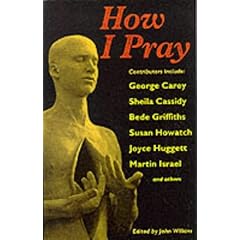
(PS the image on the book cover is of a 1992 sculpture called I It Am by Olivia Sanders. It perfectly images my experience of prayer - I'd love to see a full picture, or the real thing - has anyone ever seem it?)

Desert Wisdom II

A hunter in the desert saw Abba Anthony enjoying himself with the brethren and he was shocked.

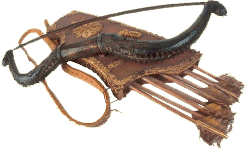
Wanting to show him that it was necessary sometimes to meet the needs of the brethren, the old man said to him, 'Put an arrow in your bow and shoot it.'
So he did.

The old man then said, 'Shoot another,' and he did so.

Then the old man said, 'Shoot yet again,' and the hunter replied
'If I bend my bow so much I will break it.'
Then the old man said to him, 'It is the same with the work of God. If we stretch the brethren beyond measure they will soon break. Somtimes it is necessary to come down to meet their needs.'

When he heard these words the hunter was pierced by compunction and, greatly edified by the old man, he went away.

As for the brethren, they went home strengthened.
How much is there to say about this?
It is quite simple: even hermits in the fourth century need holidays. And if they do, so do we, living with our taught, tense and 'highly strung' life-styles.

Let us listen and learn so that through rest we too may be strengthened.

Desert Wisdom I


We have a weekly email going out over the university holidays based upon the sayings of the desert fathers, a fascinating group of fourth-century Christians who fled the newly Christianised Roman Empire and it's civilized life for the adversities of the desert, here's one of the excerpts...

A certain brother came to Abbot Silvanus at Mount Sinai, and seeing the hermits at work he exclaimed: 'Why do you work for the bread that perishes? Mary has chosen the best part, namely to sit at the feet of the Lord without working'.

Then the Abbot said to his disciple Zachary: 'Give the brother a book and let him read, and put him in an empty cell'.

At the ninth hour the brother who was reading began to look out to see if the Abbot was not going to call him to dinner, and sometime after the ninth hour he went himself to the Abbot and said: 'Did the brothers not eat today, Father?'

'Oh yes, certainly,' said the Abbot, 'they just had dinner'.

'Well,' said the brother, 'why did you not call me?'

'You are a spiritual man,' said the elder, 'you don't need this food that perishes. We have to work, but you have chosen the best part. You read all day, and can get along without food.'

Hearing this the brother said: 'Forgive me, Father'.

And the elder said: 'Martha is necessary to Mary, for it was because Martha worked that Mary was able to be praised'.


Often I find myself giggling when I read the desert fathers. Like many monks I have met, something about living in community brings out and ripens in them a keen sense of humour (Jorge in Umberto Eco's Name of the Rose - currently serialized on Radio 4 - would not have approved!).

Abbot Silvanus gently deflates the young brother's misunderstanding about the 'spiritual life'. The truth is, that none of us can be detached from our bodies and their needs - or our neighbours - and imagine we can enter some form of nirvana privately in our 'souls'.

This is too inhuman - and also too unholy - a path. The message of the Incarnation is basically that 'matter', 'work', 'food' and so on, are good. (Indeed, 'very good', as the Creation story in Genesis puts it - not just necessary).

Though occasionally the hermits did experience strange 'phenomena' (visions of angels etc), the concept of 'spiritual' was really about becoming more fully human. If you like, in this last desert these hermits hoped to return to the first Garden - to an original harmony.

Those who have watched the recent series The Convent, or it's predecessor The Monastery, may have noticed that the vocation the nuns/monks are pursuing is not about achieving some personal 'spiritual' ecstasy. It is much more basic: it is how to live together as God intended, being the person each has been called to be.
I wonder whether the question I ought to ask myself more often is not 'how spiritual am I?', but 'how fully human am I?'.

Who gets the kids?

Thanks to Maggi Dawn for the pointer to Dave Walker's all too true cartoon about the potential break up of the Anglican Church.

More letterbox angels

Yet another odd collection of unbidden donations was posted through our door (this time at 11.30pm) with no indication of the sender. Aside from a well-thumbed copy of Pope's Rape of the Lock and a peculiar local amateur dramatics video, there was also an essay on Jonathan Swift and scatology.

Nosing through the essay, I learnt that mouth-to-mouth resuscitation was only one method of revival favoured in the Eighteenth century. Fumigating the rectum with tobacco smoke was thought of equally highly...

I'm sure Abraham didn't have this trouble with his celestial visitors.