Search This Blog

Does faith stay the same or does it change?


I've been reading a book on the spirituality of the Psalms recently. It's writer, Walter Brueggermann, uses a three-fold classification to speak about the faith of the psalmists which I've found helpful.

First, he claims, there are the many simple psalms of trust. In them the writer/ singer tells of God's safe ordering of the world. In those psalms the world appears a safe place where God is in total control. Such psalms could be said to represent a 'pre-critical' stage of faith where everything is taken on trust, no questions are asked.

But then there are those Psalms which accuse God of being absent or asleep or of not caring. These are a second group: the questioning psalms, 'where are you God?' The writer/singer feels unjustly abandoned. The world is not fair. We might say that such psalms represent a 'critical' stage of faith.

Finally there are those psalms which involved a reconciliation of those two earlier stages. Yes: in the world dreadful things happen, God's power is indeed questionable. But through the storm the psalmist has come to a deeper trust. We could call that a 'post-critical' faith which both contains and surpasses what has gone before.

As I was reading I began to think about my own journey of faith and, indeed, I could see those different stages: naive faith, angry questioning, a deeper acceptance. And it has not happened once but, like a spiral, I go through those processes and (hopefully) find myself ascending in faithfulness.

I found the book's observations helpful. Faith is not static. To have faith means to enter on a journey, not to arrive at a destination. And on that journey both the simple trust and the angry denial have their place...

Gift

The more I explore faith, the more I come to see that the concept of 'gift' is an essential one.

If I were to put that into an image, I think it would be a picture of a pair of
outstretched hands, palms held upwards (a gesture, appropriately, many use in prayer).

The Oxford English Dictionary defines 'gift' as 'something, the possession of which is transferred to another without the expectation or receipt of an equivalent'.

Gift resonates with me at many levels:
the gift of the universe,
the gift of my own life within it - for a brief time (who knows how long?)
the gift of those who have loved me.


I have not asked for these things, they have come to me freely, often with an element of surprise. A response of thanks from me has often been forthcoming - but not expected.

Not surprisingly 'gift' seems to be written into the very nature of God:

God, the one who 'gives' space for creation to be,
who, in the Christian tradition, 'gives' God's self in the Incarnation sharing our precarious tragically-beautiful existence,
who 'for-gives' the murder of Christ,
and who returns Christ to the world with the 'gift' of the Spirit.

My wife was in a Bible study group recently discussing the motivations for
sharing faith with others which led us to ponder our feelings on this subject.

On reflection what ultimately drives me as a Christian is the desire to put others in touch with their 'giftedness' so that they may feel and know again the surprise and joy again of their existence.

And beyond that, to encourage them to return 'thanks': to live out their giftedness in such a way that others, too - whose lives may be limited by health, wealth, outlook and environment - can more fully discover their lives as gift.

It's summed up for me at the end of the Anglican Communion service, when after receiving the 'gifts' of bread and wine we pray:

Almighty God, we thank you for feeding us with the body and blood of your Son Jesus Christ, through him we offer you our souls and bodies to be a living sacrifice. Send us out in the power of your Spirit, to live and work to your praise and glory. Amen.

Billy Bragg, Patriot

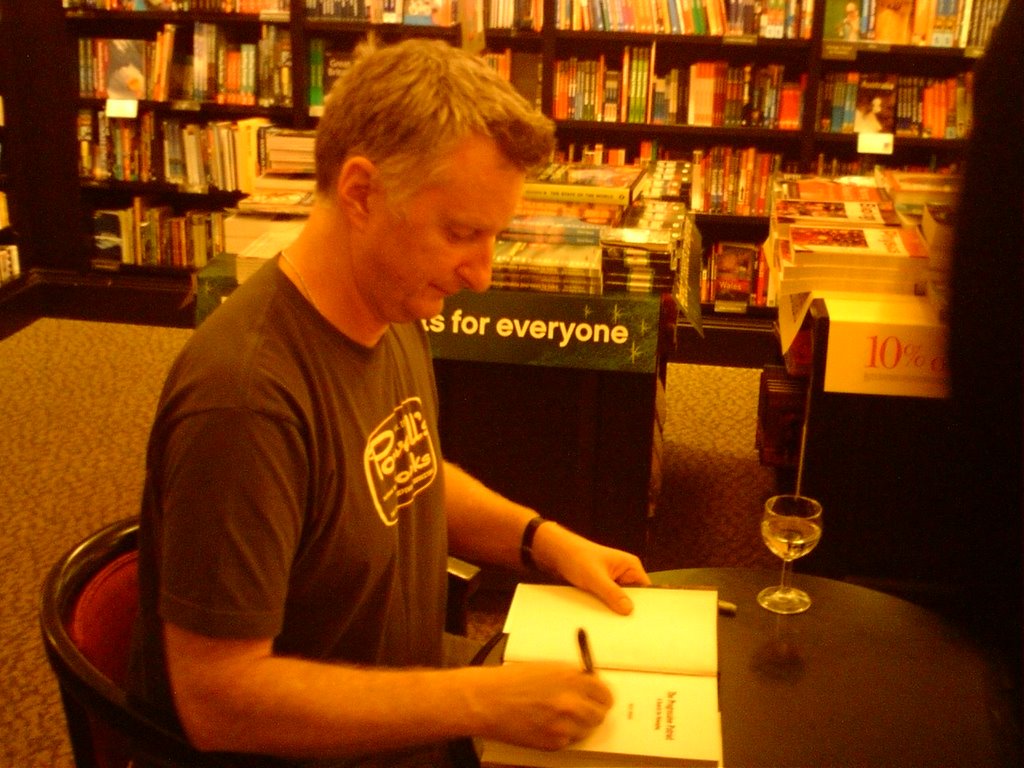
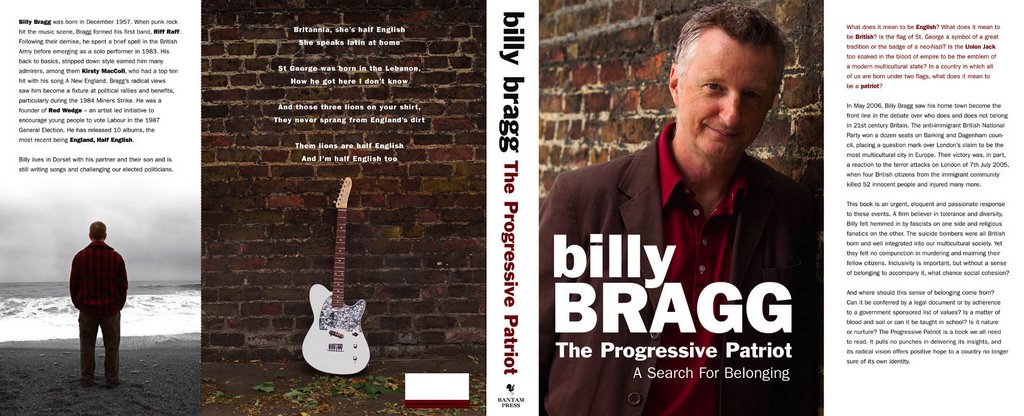
I got to see a folk hero of mine, Billy Bragg, speak about his new book The Progressive Patriot, A Search for Belonging tonight.

Billy talked about the origins of the book in his disgust at the election of a BNP councillor in his home town of Berking and Dagenham in Essex.

Since his previous album, England Half English, Billy has been trying to reclaim a sense of Englishness from a right wing agenda.

Tonight he spoke about his first stirrings of an English identity when, ironically, hearing Simon & Garfunkel's Scarborough Fair played to him at school (S&G drawing on the English folk scene when they visited Britain).

Billy related how his political roots solidified in the Rock Against Racism carnival of 1978 when 100,000 people 'just like me' had the courage to challenge racism and - as Bragg found himself standing under a gay liberation flag and finding himself listening to Tom Robinson's 'Glad to be Gay' - he also realised the connection between racism, homophobia and sexism.

Since then he says he has had a faith in popular culture to change the world (something reflected in his recent song 'I Keep Faith') and the ability of a performance to change the perspective of an audience's thoughts.

His new book apparently sets out counter arguments to contemporary racist nationalism and puts forward instead a new agenda for patriotism based on the concept of belonging.

Halfway through writing the 7/7 bombings occurred and this is reflected in the book, he said. He commented on how, externally, the bombers were thoroughly 'assimilated' to British culture (in one of the suicide bomber's videos he noted how the bomber was speaking "with a flat Yorkshire accent") but in fact all of the bombers lacked any real sense of belonging.

Typically Bragg rejects the Telegraph/Daily Mail call for a return to 'British values', claiming that they are meaningless, and instead he alights on the concept of 'fair play', tracing it back through various popular historical rejections of arbitrary power (Magna Carta, the Civil War, the Luddites, Chartists and Suffragettes, and the Second World War.)

The celebration of that - in particular through creation of a Bill of Rights - rather than the current identity of "Brits being most famous in Europe merely for getting arse-holed and falling down at 3am..." will be more useful for creating a unified sense of identity, he said.

"Fairness is the great social engine of change"


He's now urging that Britain should spend the new year (the 300th anniversary of the creation of the UK) discussing how to create a new written Bill of Rights setting out popular freedoms and responsibilities and that this he believed would help reengage people politically.

His bottom line was, "I don't care what you believe, I just want to know how are my kids going to get on with yours?"

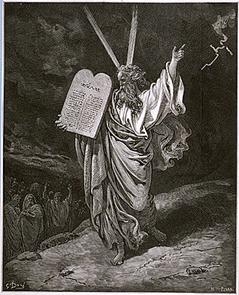
The Book of J

Outside of theological departments few Christians will perhaps have ever heard of 'the Book of J'. One of the interesting products of nineteenth century Biblical scholarship was a close attention to the composition of the Bible.

Julius Wellhausen first systematized the theory (called the Documentary Hypothesis) that within the first five books of the Bible (the Torah/Pentateuch) at least four different textual strands can be seen.

He (and others before him) began by noting that the Pentateuch contained strange repetitions. The most obvious of these is the two creation stories.

Genesis 1:1-2:3
is a stately ordered sequential narrative with God as the majestic unseen architect of Creation. But it is followed by an entirely different telling in Genesis 2:4-25 which is wonderfully idiosyncratic and down to earth. In the second tale God is shown in a far more hands-on manner, getting God's hands dirty in clay and walking in the garden.

Thereafter by separating all the different versions, and clumping together texts with common vocabulary and themes, Wellhausen came up with his four different documents. He named them J, E, D and P (follow the links to learn more about the different hypothetical sources) and assigned different dates, authors and locations to each of them.

Of course none of his theories can be proven and some more recent scholars (and most Christians) are content to simply work with the text as it stands and pay no attention. After all, all we have is the Pentateuch - everything else is conjecture!

However even though remaining agnostic about JEDP, Wellhausen's theories can still be useful. They can work rather like a pair of glasses through which the messiness of Genesis-Deuteronomy can come into focus and potentially explained.

Personally I have come to find it helpful to understand parts of the Bible, like the Pentatuech, as composite and thereby to explain so-called contradictions as different 'voices' within Scripture. I prefer to do that than to follow the other route which is to harmonize out all the differences.


Wellhausen believed that 'J' (a text which names God YHWH throughout - Jahve in German) was the earliest. Since then various people have tried to look through the Pentateuch to find J and to see what the earliest Hebrews believed about God. Harold Bloom's book, which I've recently been reading, is an attempt to create an edition of J.

Bloom is a literary scholar and a poet, and he allows his imagination to flow free. His J is a female poet in the court of Solomon telling a tale which is not specifically theological. According to Bloom, J is to be read more like an early Shakespeare than a Hebrew Saint Paul - just for the beauty of the text.

One might choose to disagree with all sorts of comments Bloom makes. To my taste he is too rabidly averse to traditional Jewish and Christian readings of Scripture. But what he does achieve wonderfully is to let the humour of some parts of the Pentateuch come to the surface.


My favourite is the quite simple observation that the second Creation story is full of gender irony. There J tells of YHWH messing around and creating a man out of clay, more or less like a child with play-dough. Human Mark 1 (male) is an imperfect crude thing. After various experiments looking for a partner YHWH hits upon the idea of making Human Mark 2. This time YHWH's design specifications are more sophisticated and 'Woman' comes to be constructed out of a rib.

The result in J's creation story is a contrast between Humans Mark 1 and 2 which points all the way to the superiority of the newer version. With irony J sheds a bright light on the differences between male and female and the relationship between the sexes.

The Book of J is an curious read. For my money though, an easier more sympathic entry to the world of reading Bible texts both faithfully and critically would be Richard Elliot Friedman's Who Wrote the Bible?.

Though some might find it threatening, and others unhelpful, there will be some Christians who will find the JEDP theory (and other theories like it) useful in showing that there may be many ways to read the Scriptures with care and faithfulness.

New Cockburn Album

Just working my way through the new Bruce Cockburn album: Life Short Call Now.

I got into Cockburn's music back in the 90s at University when I heard a really old album, Stealing Fire (1984). I was struck by the power of his lyrics. I think it was the song Lovers in a Dangerous Time which ultimately got me hooked (listen here - press the play button):

Don't the hours grow shorter as the days go by
You never get to stop and open your eyes
One day you're waiting for the sky to fall
The next you're dazzled by the beauty of it all
When you're lovers in a dangerous time
Lovers in a dangerous time

These fragile bodies of touch and taste
This vibrant skin this hair like lace
Spirits open to the thrust of grace
Never a breath you can afford to waste
When you're lovers in a dangerous time
Lovers in a dangerous time

When you're lovers in a dangerous time
Sometimes you're made to feel as if your love's a crime
But nothing worth having comes without some kind of fight
Got to kick at the darkness 'til it bleeds daylight
When you're lovers in a dangerous time...

Desert Wisdom VII


Amma Syncletica said, 'Just as one cannot build a ship unless one has some nails, so it is impossible to be saved without humility'.


We've had lots of comments from Desert Fathers - this week a comment from one of the less well known Desert Mothers, Syncletica.

Her little saying is a tiny gem of wisdom. We probably don't naturally twig that the 'ship' metaphor is a reference to Noah's ark and how he and his family were 'saved' from the flood. Humility therefore, she says, is the way we are held together spiritually, like nails keeping stubborn planks of wood tight against water.

Many Christians might scratch their heads and say (with Martin Luther) isn't it grace that saves us, rather than anything we do?

I don't think Amma Syncletica would have disagreed. But she would have seen salvation as more than getting a free ticket into heaven. For her 'being saved' means being transformed. God's saving of us is a life-time's work of construction. And here the 'nails' metaphor of course also resonates with the Crucifixion story, and indicates that being humble about ourselves can be a painful thing as God tries to pin the planks of our identity back into their rightful place.

Of course, God unconditionally loves and accepts us. And more, God also wills humankind to be fully transformed so as to be like God.

Our response then is precisely as Syncletica says, to be humble about the ways we need to be re-formed and honest about our areas of stubbornness that threaten to sink us as we make our journey into God.

Review of The Stripping of the Altars

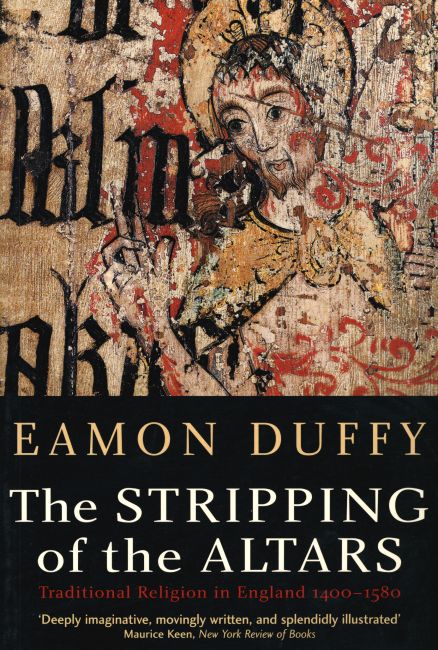
Eamon Duffy's major tome on religion in Pre-Reformation England is no mean read - and not just from the point of view of its length. The Stripping of the Altars is a major argument with previous historians of the English Reformation. But it is riveting and enlightening stuff.

Other writers had held (and it still has some degree of popular acceptance) that the English Reformation swept away a decadent and degenerate Roman Catholic English Church which was failing to bring the Christian faith to the masses.

Duffy (a Catholic himself) sets out to argue that the Catholic Church was vibrant, reforming and above all popular. He argues, along with many others, that the English Reformation was the unexpected result of Henry VIIIs political machinations, the largely unpopular dominance of his successor Edward's Protestant clique, and the early death of the Catholic Mary.

For those who have no idea what Pre-Reformation English Christianity looked like, in the first half of his book Duffy explains the role of the Mass, prayers for the dead, pilgrimages and the like. What emerges is a Christianity that seems gloriously colourful, often very piously focused on images of the suffering Christ and, with its cult of intercessary prayer to the Saints in some ways visually similar to Hinduism (for example statues decked with beads and clothing).

Some Christians might grit their teeth at this, but the first part of Duffy's work is simply a reminder of how other Christians have lived their faith. At points I found myself moved by the popular piety of the prayers many lay Catholics would have said and was led to reopen my copy of Julian of Norwich. At other times I was made to feel uncomfortable: indulgences for Purgatory are a difficult concept even for many Catholics.

In the second part Duffy looks at what really happened on the ground: how much did people really want to become Protestant? Historians now have the benefit of local documents, such as church wardens' reports, which can shed light on how individual church communities behaved. Though a few congregations did undeniably welcome royal decrees to, for example, remove images, most of these were urban churches in ports with connections to continental Protestant populations.

Many of the more rural churches dragged their feet when ordered to reform, hid images and crosses (which promptly reappeared when Mary revived Catholicism), and bent the rules as much as they could. Duffy reminds us that one has to bear in mind the significant fines and punishments that existed for disobeying royal orders to destroy Catholic relics and objects. But he also shows how much congregations valued their images, crosses and relics, often having paid large sums of money to purchase them, indicating the popular nature of much Catholic ritual.

Duffy's reading of history is a 'we was robbed!' one (as described by the Oxford historian, Christopher Haigh). According to Duffy few wanted the English Reformation, but with the length of Elizabeth's reign people and communities simply forgot what the past had been like: the memory was lost. Inevitably there are issues he skates over - he doesn't major on the effect of the Marian burnings, or the popularity of the Bible in English, for example.

Duffy's work then is something of a paean for a lost world. And reading his narrative of religious destruction (though he doesn't even treat the destruction of the monasteries) it's difficult not to feel wistful. How would churches look if they still had popular art all over their walls, if pews didn't clutter naves but left them open for communities to hold public events?

It is undeniable in hindsight that some of the aspects of the Reformation impoverished Christianity, slimming it down to a narrow focus on words only and no pictures (something we are gradually climbing out of again - how many Protestant churches now use art in Powerpoint displays to accompany sermons?). Many of the alternative worship events I have been to over the past years implicitly (and sometimes explicitly) draw on Pre-Reformation rites: lighting candles, using icons, going on pilgrimage, using water, wood and stone to pray with.

Ultimately the post-Reformation period under Elizabeth bequeathed a State Church which papered over the cracks of Protestant and Catholic, that left wiggle room for high and low alike. At this time, as an Anglican, it still seems clear to me that the ambiguous after-effects of the English Reformation and the deep psychological trauma it engendered are still very much a live issue.

(For those who might feel daunted by his tome, Duffy has written a shorter study of the effect of the Reformation in one tiny Church, called Voices of Morebath).